Provided by Adobe Stock
Testing for prostate cancer includes a PSA blood test, which measures protein specific antigens produced by the prostate gland.
Whether you have a family history or not, cancer can strike anyone. According to the American Cancer Society, prostate cancer is the second most common cancer in men in the United States. While risk can vary based on a person’s age, race, and ethnicity, studies show 1 in 8 men will be diagnosed in their lifetime. Doctors say it’s best not to skip preventative testing and get screened.
“As men get older, they have more issues with their prostate, leading to an increased chance of having prostate cancer,” said Dr. Oussama Darwish, a urologic surgeon at Arnot Health, a member of Centralus Health.
Chances are, if you’re a man over the age of 45, your doctor has talked to you about prostate cancer screening anyway. Getting tested early helps doctors establish your baseline, detect any signs of cancer, and provide treatment with significantly better outcomes. Unlike a colonoscopy, the test does not require any preparation, only a small poke.
“Testing for prostate cancer, which is usually done by a blood test, looks for PSA, or prostate-specific antigens. The earlier we get the PSA, the earlier we identify the disease and the better we can manage it,” Dr. Darwish said.
Blood tests can measure your PSA levels, which is the protein produced by the prostate gland.
“It’s probably a good idea for any man above age 45 to have a baseline PSA test once to have an idea of whether or not his PSA is high for his age. Having a baseline of your numbers early on in life is a good way to predict any possible cancer in the future.”
Elevated levels can sound the alarm for cancer, but it’s not necessarily a reason to panic. High PSA levels can be caused by benign prostatic hyperplasia or BPH, and prostatitis, both which affect the prostate gland. This can be a sign that the prostate is enlarged due to an infection or hormonal changes caused by aging. Doctors say BPH and prostatitis usually affect older men, but knowing your numbers can give you some insight into your health.
“If the PSA is high, they should follow up every few years on that. It really relieves the patient to know what kind of disease he may have and if this will affect his future health or not.”
Provided by Cayuga Health
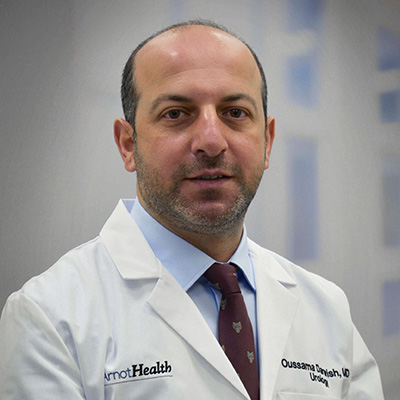
Oussama Darwish, MD is a Urologic Surgeon at Arnot Health, a member of Centralus Health
Urologists recommend being proactive, especially those with a first-degree relative diagnosed with prostate cancer. Those men are at more than twice the risk. If a parent, sibling, or child in your family has been diagnosed with cancer, Dr. Darwish says it’s important to let your primary care provider know.
“In the urology community, we recommend being more consistent in checking patients with a history of prostate cancer or breast cancer in their family because it doubles the risk of having prostate cancer in the future.”
Certain genetic variations can affect someone’s chances of developing prostate cancer. This is especially true for people of African American heritage between the age of 55 and 65, who are at higher risk of having more aggressive cancer.
Screenings don’t need to be done with a specialist, like a urologist. Dr. Darwish says family medicine providers can help patients figure out the best approach to getting tested.
“The first line of defense is a primary care physician. If the patient feels he needs to be assessed by a urologist, he can come to us at any time.”
Primary care physicians may perform more than one screening. A digital rectal exam, one most people associate with prostate-related screening, is done manually. Doctors will insert a lubricated gloved finger into the rectum to check the size, shape, symmetry, and texture of the prostate gland. This exam allows them to feel any nodules, lumps, or hard areas.
“This will help the urologist and the patient feel more confident that, if they have more aggressive cancer, they can be treated and cured from this cancer in the future,” says Darwish.
Detecting cancer doesn’t mean jumping straight to treatment like chemotherapy, radiation, or immunotherapy.
“Take into consideration that most prostate cancers are indolent and most likely will not need any surgery or treatment intervention in the future.”
Indolent prostate cancer is slow growing, unlikely to spread outside of the prostate gland, and usually poses a minimal threat to the patient’s health.
Arnot Health’s urology office is located at 301 Hoffman Street, Elmira. Call (607) 733 – 1156 to make an appointment. Referrals from a primary care provider are encouraged but not required.
Cayuga Health’s urology office is located at 201 Dates Drive, Suite 102, Ithaca. Call (607) 319 – 5747 to make an appointment. Referrals from a primary care provider are encouraged but not required.